


Trading in perpetual futures tied to stocks, gold, and other traditional assets is growing fast. And most of that activity is happening on centralized exchanges.
These contracts, often referred to as real-world asset (or RWA) perps, give traders exposure to the prices of traditional assets without actually buying the asset itself. Unlike conventional futures, they don’t have a scheduled expiration, and some venues also offer 24-hour trading, seven days a week. This includes weekends, when major commodity futures markets and stock exchanges are closed.
Demand is rising quickly: Across tracked venues, monthly RWA perp trading volume reached $701 billion in August, up 1,148x in a year. Open interest, a measure of traders’ market exposure, reached $9.3 billion. And most of that activity is happening on centralized exchanges, which now account for 85% of RWA perp volume.
Note: While a small number of U.S.-regulated centralized platforms offer products similar to perpetual futures contracts to U.S. persons, only one venue has been approved to trade one perp at this time. All other centralized and decentralized exchanges restrict U.S. persons’ access to true perpetual futures contracts.
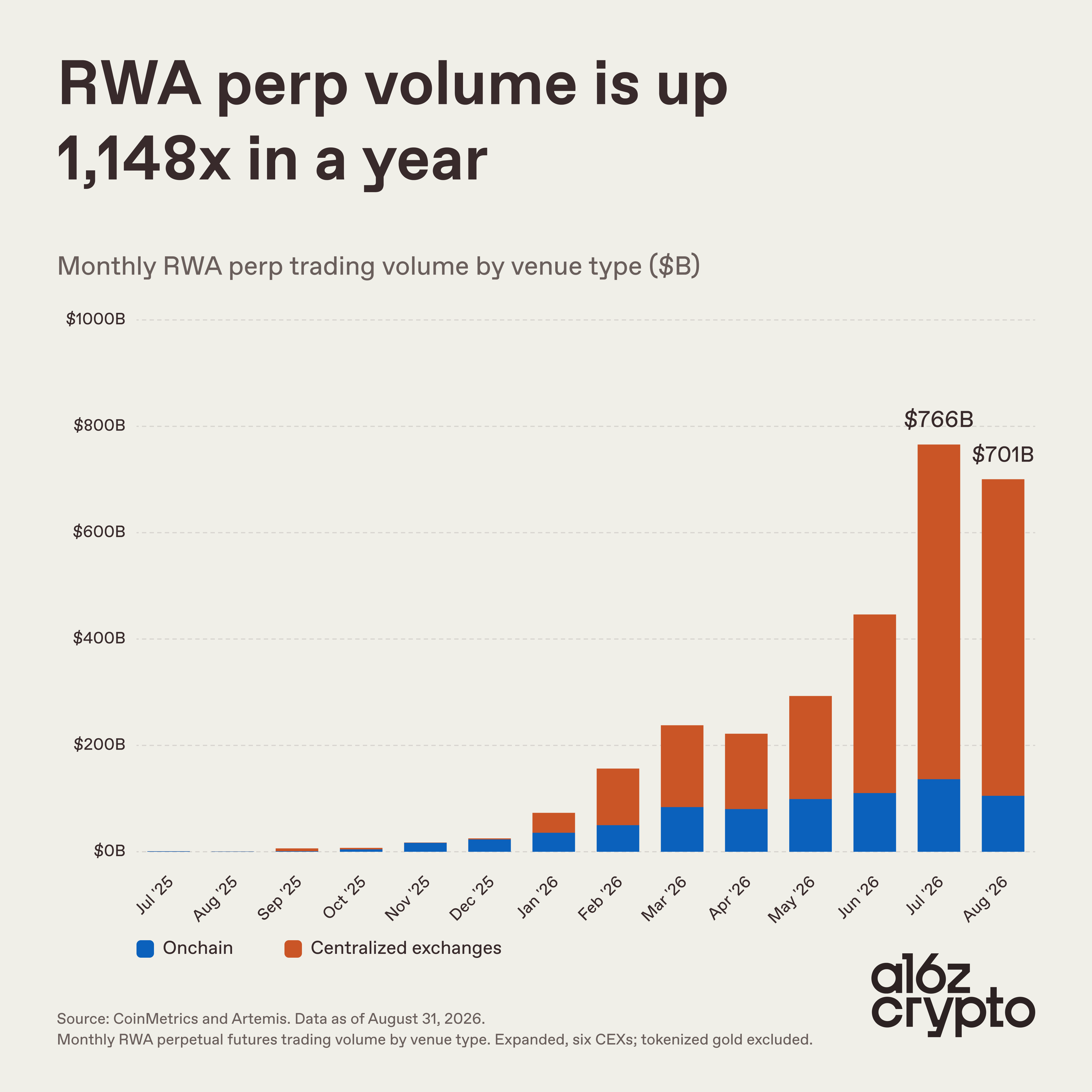
After a down month in April, volume recovered to a new high in May. It continued climbing to $766 billion in July before pulling back to $701 billion in August. Even then, monthly volume was 1,148× higher than the year before.
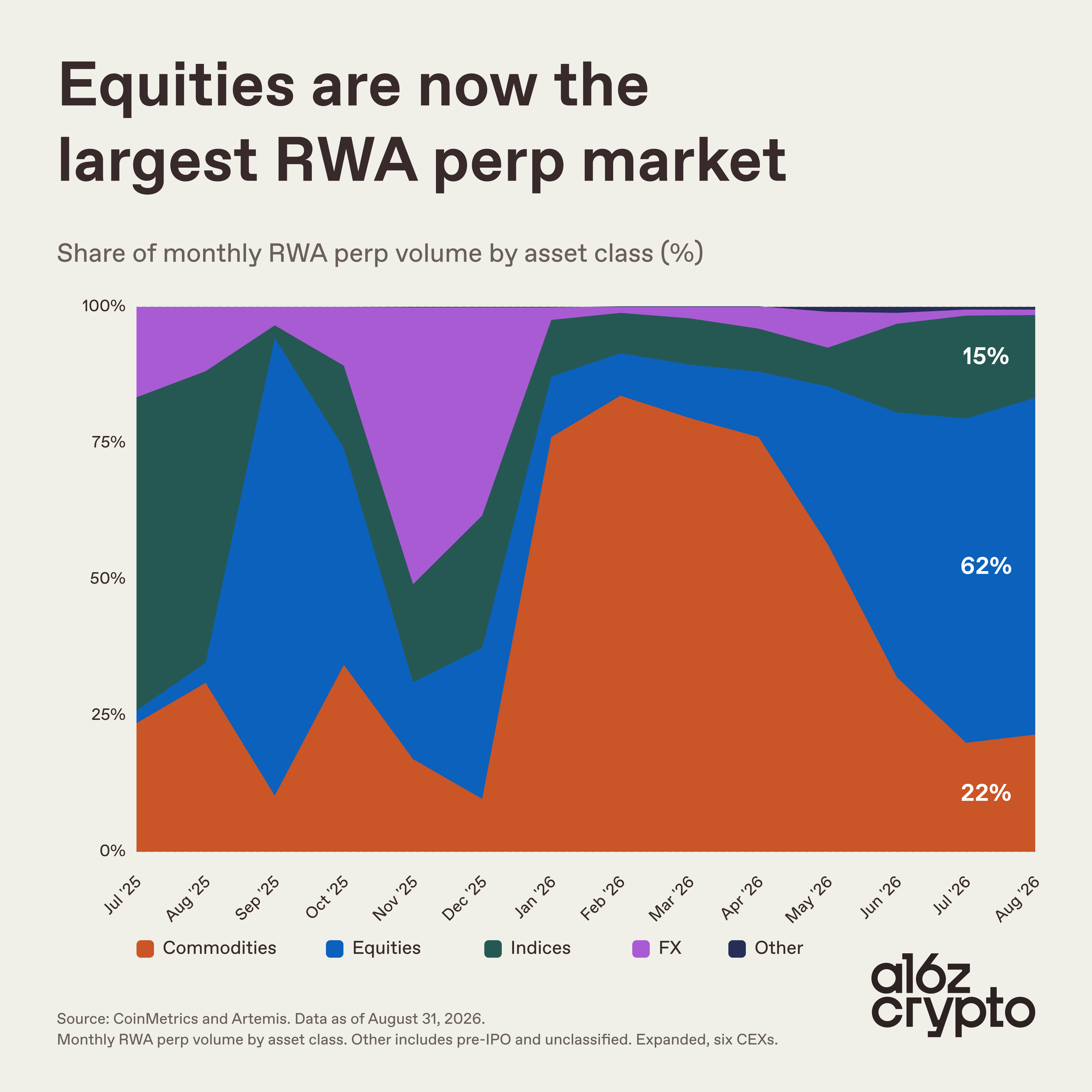
What people are trading has also changed. At the start of 2026, commodities made up roughly three-quarters of RWA perp volume and remained the largest asset class through May. Since then, the mix has shifted toward equities. As of August this year, equities make up 62% of volume, compared with 22% for commodities and 15% for indices.
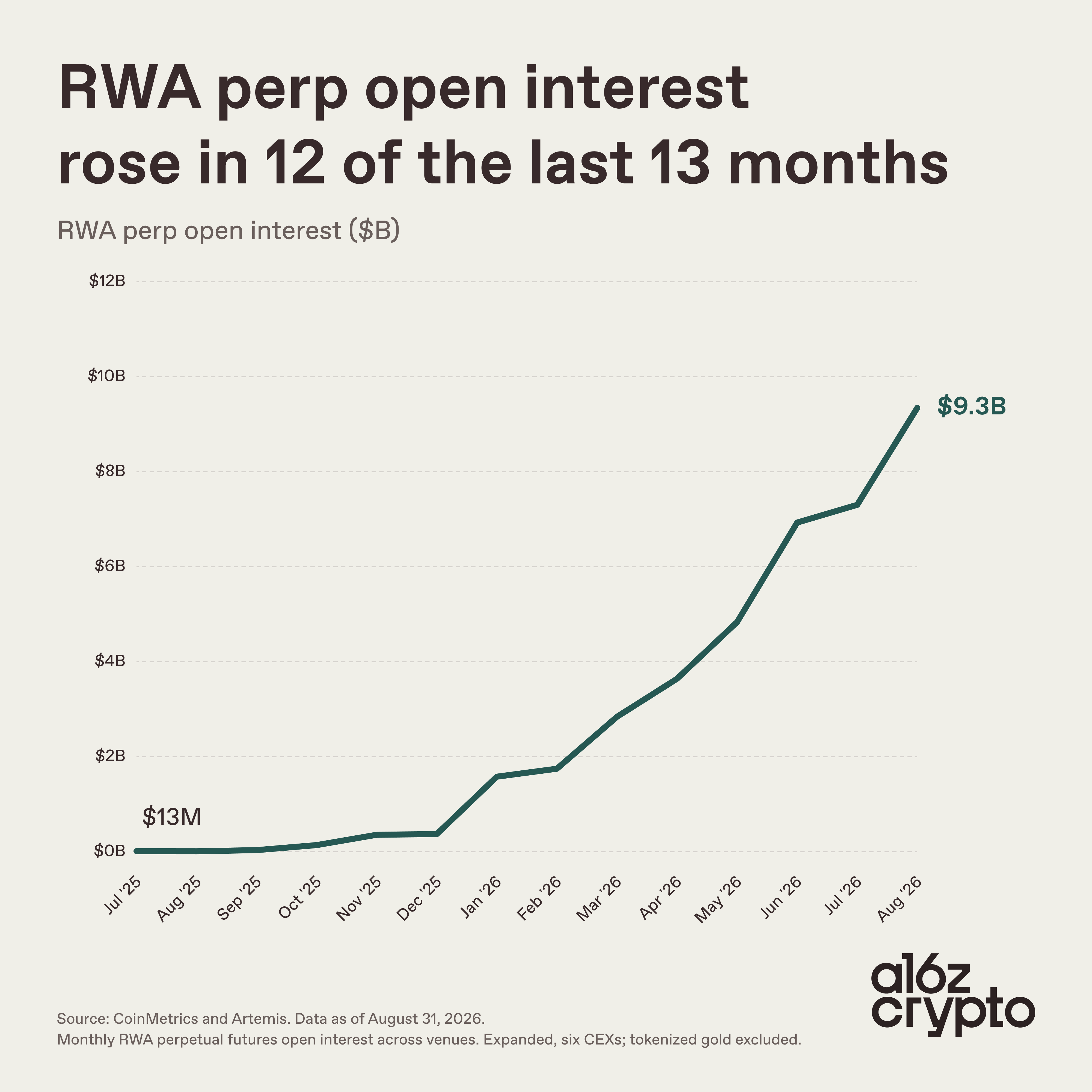
RWA perp “open interest” — which measures the notional value of outstanding contracts — climbed from $13 million in July 2025 to $9.3 billion in August 2026, increasing more than 700×. It continued to grow in April and reached a new high in August, even as trading volume fell.
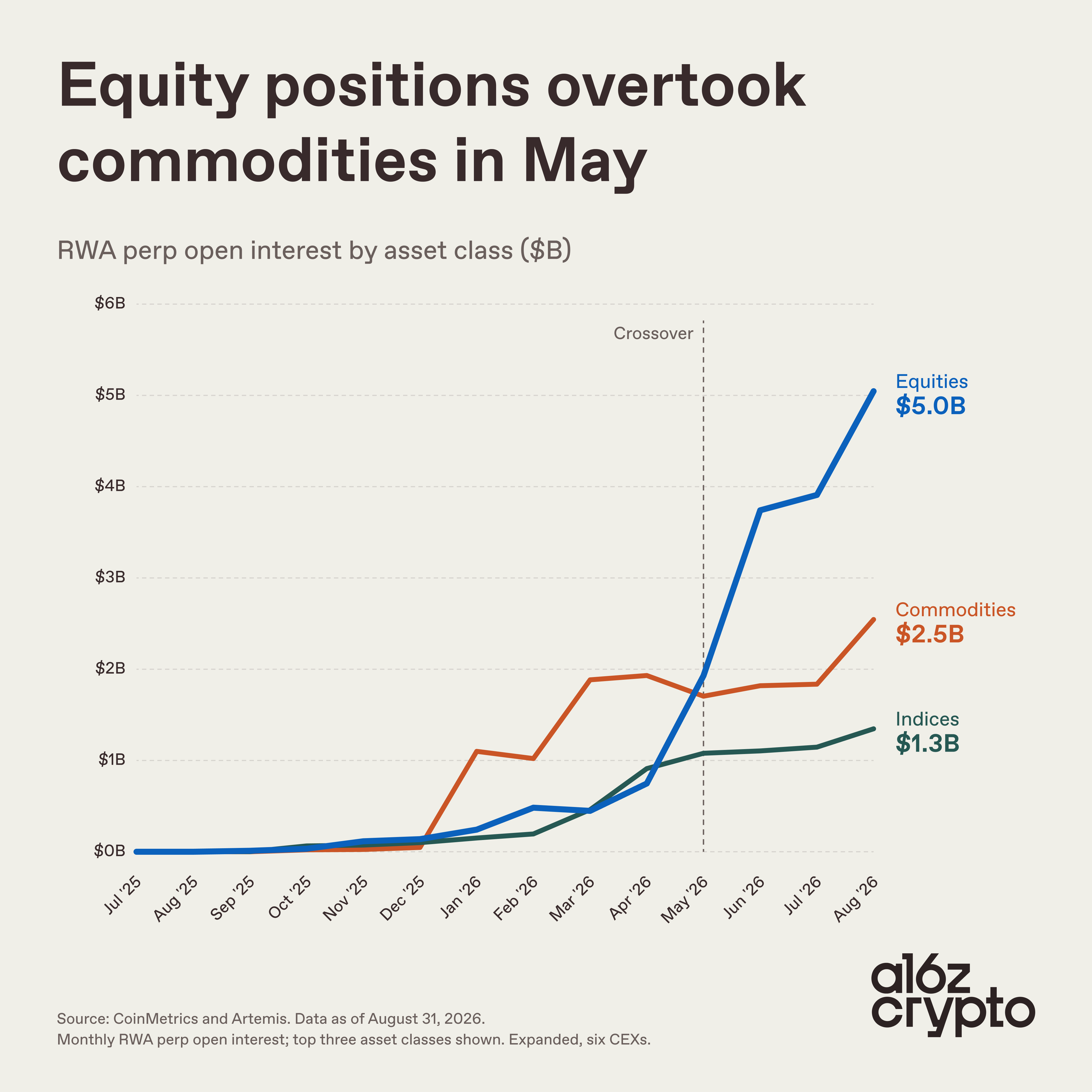
This shift toward equities showed up in open interest before trading volume. Equity open interest passed commodities in May. A month later, equity trading volume passed commodities. The gap in open interest widened through August, with equities at $5.0 billion and commodities at $2.5 billion.
RWA perp trading volume remains small compared with traditional derivatives markets, where futures and options trade in the tens of trillions of dollars per month on long-established platforms.
Yet growth in monthly RWA perp volume shows demand for traditional-market exposure onchain is no longer just a hypothetical. The next question is whether RWA perps become a standard offering at traditional brokers and exchanges.
Acknowledgments: Thanks to data consultant Ryan Holloway for charts and data analysis
Editorial Note: Perpetual futures contracts are currently regulated as derivatives under the U.S. Commodity Exchange Act and may only be offered to U.S. persons through CFTC-registered designated contract markets. As noted above, a small number of U.S.-regulated platforms offer products similar to perpetual futures contracts to U.S. persons, while most centralized exchanges and all decentralized exchanges restrict U.S. persons’ access to such products.
A strong angle here is that RWA perps are turning access into the product. 24/7 exposure to stocks and commodities without owning the underlying is a very different proposition from traditional tokenization and the rapid shift toward onchain venues suggests traders are already responding to that.
How much of the volume is washed trades? Newer exchanges have never been vigilant in policing washed trades